Day trips from Dresden
Seven places to visit from Dresden: Meißen, Moritzburg, the Bastei, Königstein Fortress, Bad Schandau, Bautzen and Görlitz, with what to see at each and how to get there.
Meißen
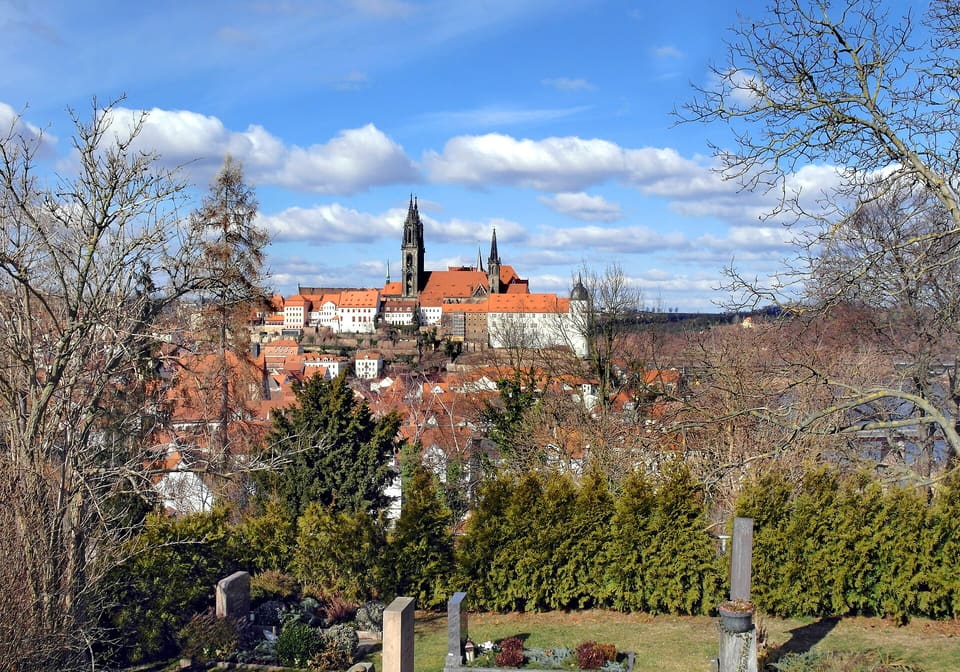
The castle hill with the Albrechtsburg and the cathedral, seen from the south. Photographed on 24 February 2018.
Jörg Blobelt Wikimedia Commons CC BY-SA 4.0
The Albrechtsburg in Meißen is a late-Gothic castle that was built between 1471 and 1524. Inside it, the Große Wendelstein is a staircase of curved steps that winds around an openwork spindle. Porcelain production in Meißen began on 6 June 1710 at the Albrechtsburg.
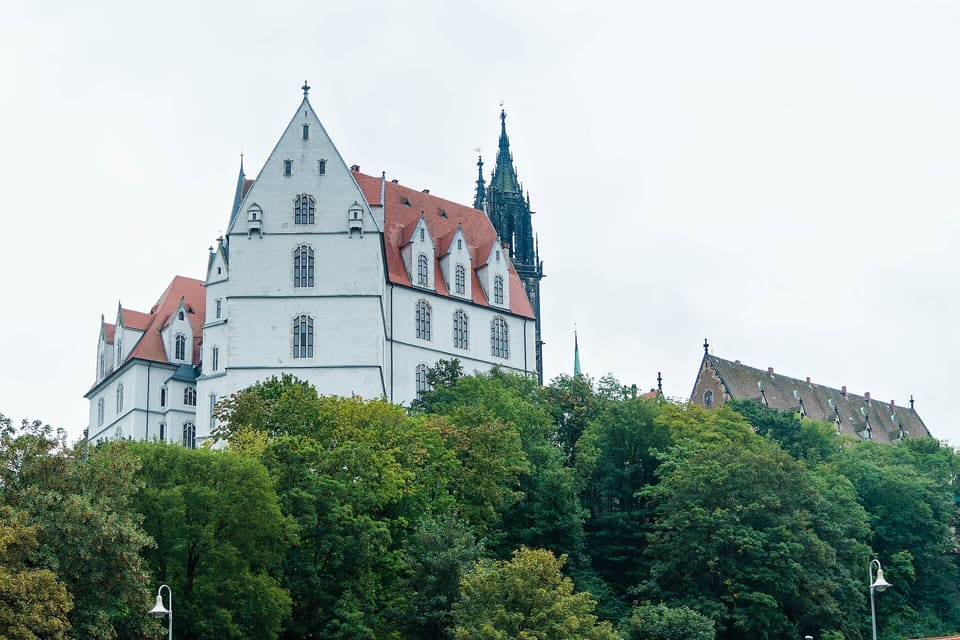
The Albrechtsburg from the north side. Photographed on 21 September 2015.
Radler59 Wikimedia Commons CC BY-SA 3.0
The Museum of the Meissen Porcelain Foundation at the manufactory in Meißen displays works from the manufactory's 300 years of history. Meißen Cathedral (Dom zu Meißen) is a building of the 13th century. A carillon of Meissen porcelain bells has hung in a window opening of the Frauenkirche tower in Meißen since 1929. Winemaking has been part of life in the Meißen region for over 800 years.
Moritzburg
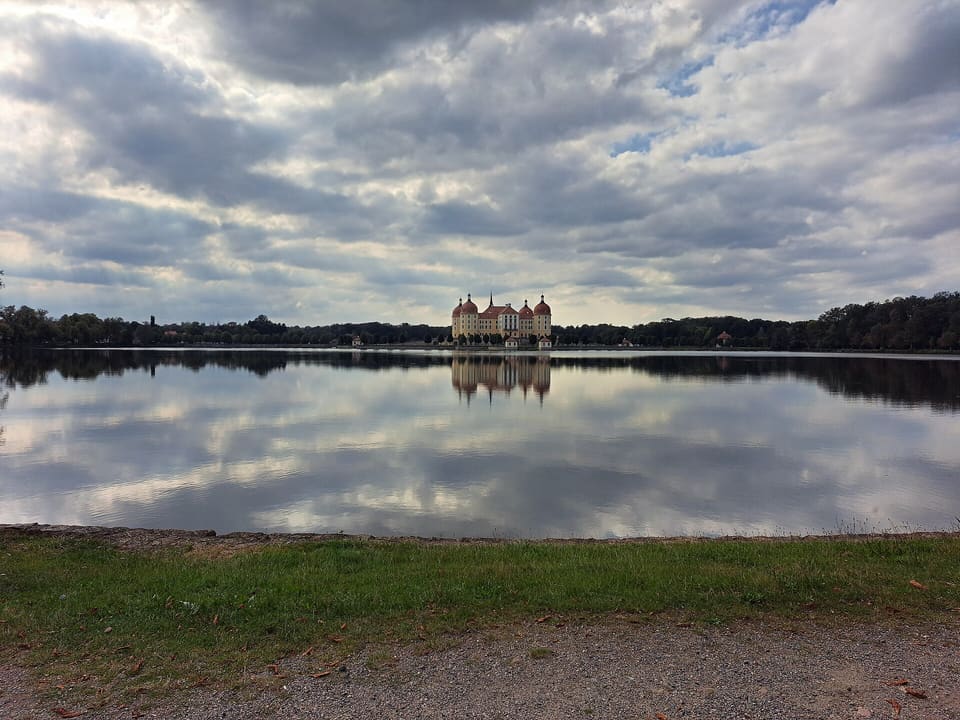
Schloss Moritzburg across the Schlossteich. Photographed on 20 August 2024.
Bybbisch94 Wikimedia Commons CC BY 4.0
Duke Moritz of Saxony had a hunting lodge in the Renaissance style built in 1542 on a granite outcrop in the Friedewald forest. Major rebuilding of the Renaissance structure into a baroque hunting and pleasure palace began at Schloss Moritzburg in 1723. The architect Matthäus Daniel Pöppelmann was commissioned with the project and had new ponds and animal enclosures laid out.
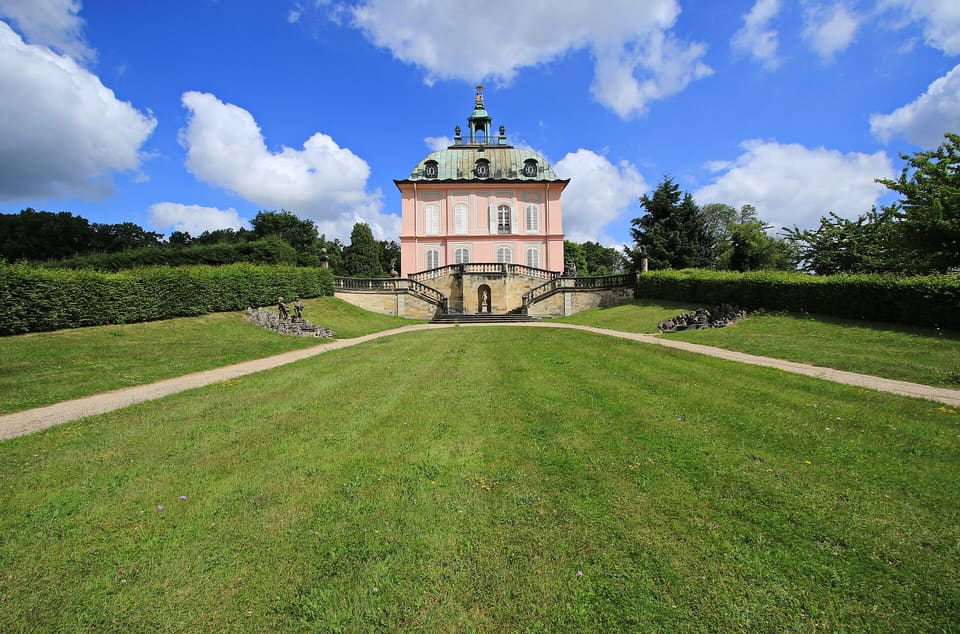
The Fasanenschlösschen. Photographed on 18 June 2017.
Kora27 Wikimedia Commons CC BY-SA 4.0
The Fasanenschlösschen (Little Pheasant Palace) was built for the Elector between 1770 and 1776 in Chinese-inspired (chinoise) forms. By royal decree of 23 January 1828, 38 stallions were to be stationed as state sires in Moritzburg's hunting stables, which were built in 1733. The narrow-gauge Lößnitzgrundbahn line was officially inaugurated on 15 September 1884. Schloss Moritzburg appears in the Czech-German film production Three Hazelnuts for Cinderella (Drei Haselnüsse für Aschenbrödel), in which Cinderella rides at a gallop to the castle.
The Bastei
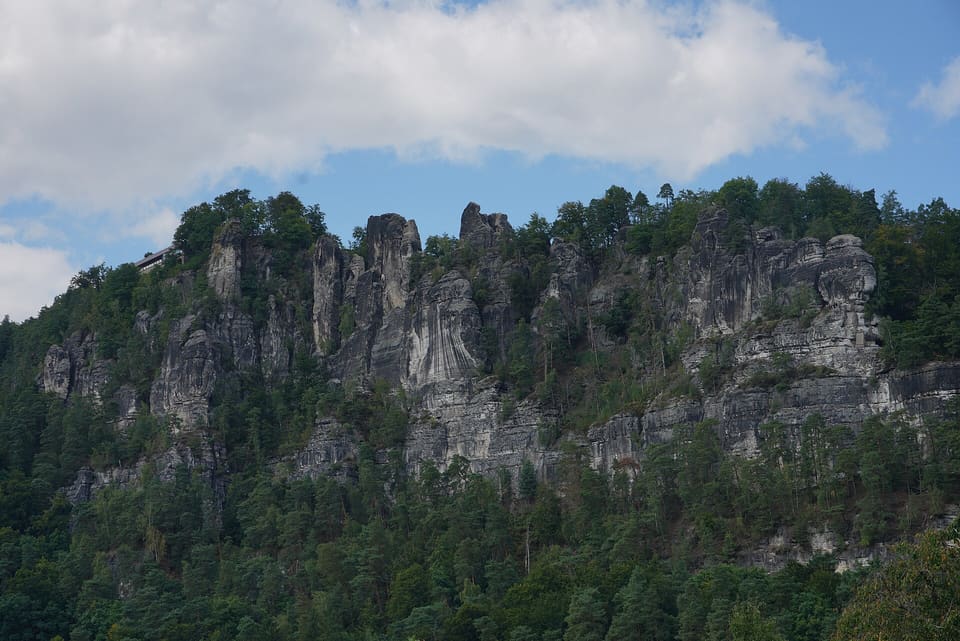
The cliffs of the Bastei. Photographed on 6 September 2025.
Lukas Beck Wikimedia Commons CC BY 4.0
The Bastei itself is a rock pulpit (Felskanzel), 305 m high according to the national park, that rises vertically 194 m above the Elbe. The present Bastei bridge was built in 1850/51, in connection with the opening of the railway line in the Elbe valley. A stone bridge links the Bastei with the rock castle Neurathen (Felsenburg Neurathen), a castle from the 13th century. The Basteibrücke is a sandstone bridge 76 m long that is specially protected today as a technical monument.
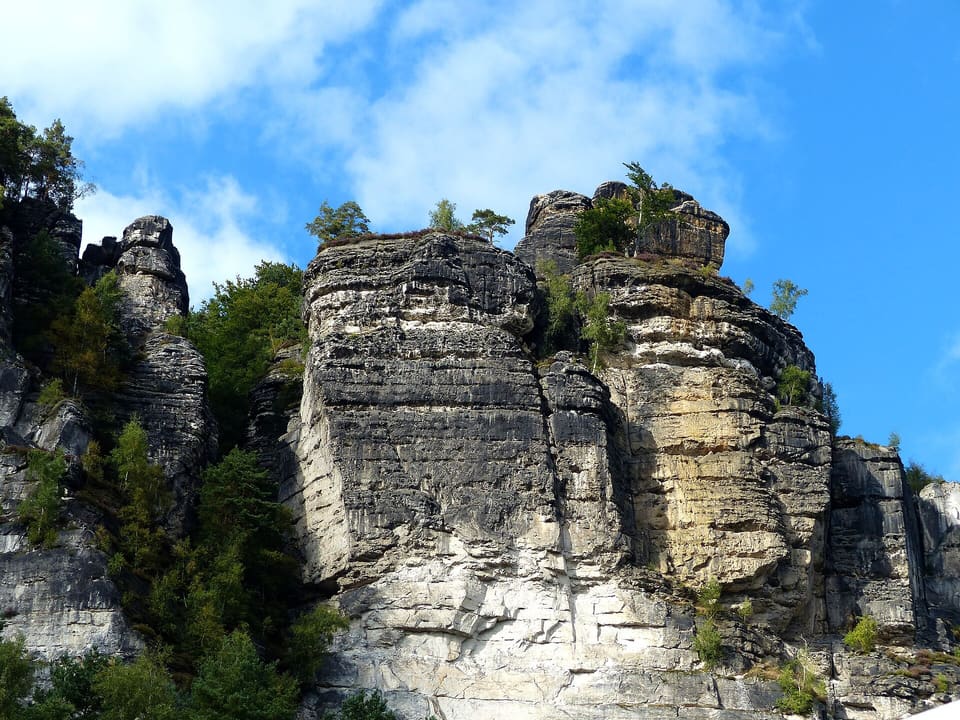
Sandstone cliffs at the Bastei. Photographed on 4 September 2013.
Geolina163 Wikimedia Commons CC BY-SA 3.0
The Felsenbühne Rathen (Rathen rock stage) was opened on 24 May 1936. In spring 2023 the Free State of Saxony opened a new viewing platform at the Bastei.
Königstein Fortress
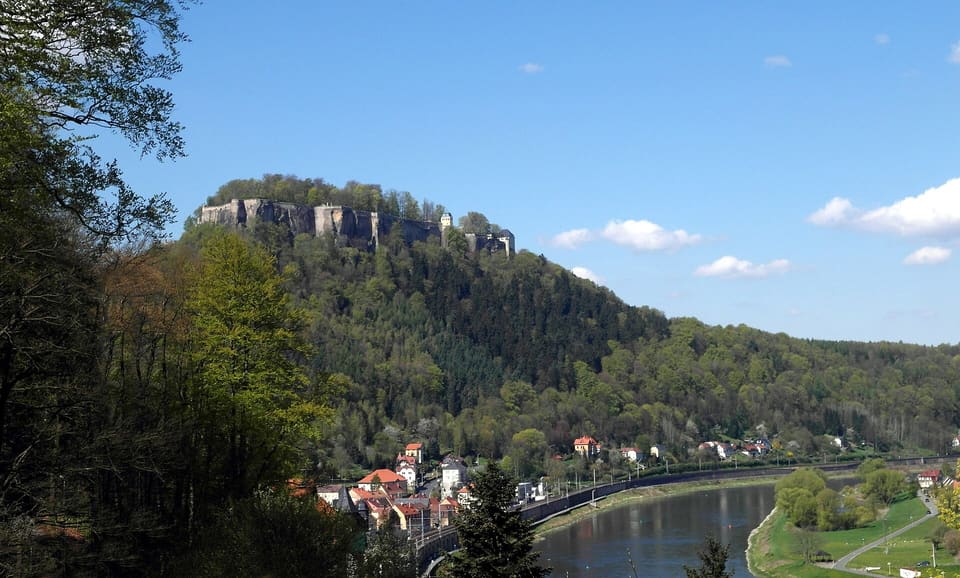
Königstein Fortress above the Elbe. Photographed on 29 April 2016.
Jörg Blobelt Wikimedia Commons CC BY-SA 4.0
The fortress complex has more than 50 above-ground and underground fortification structures from over four centuries. The fortress well is 152.5 metres deep. Miners from the Ore Mountains (Erzgebirge) sank the well under the direction of mining master Martin Planer.
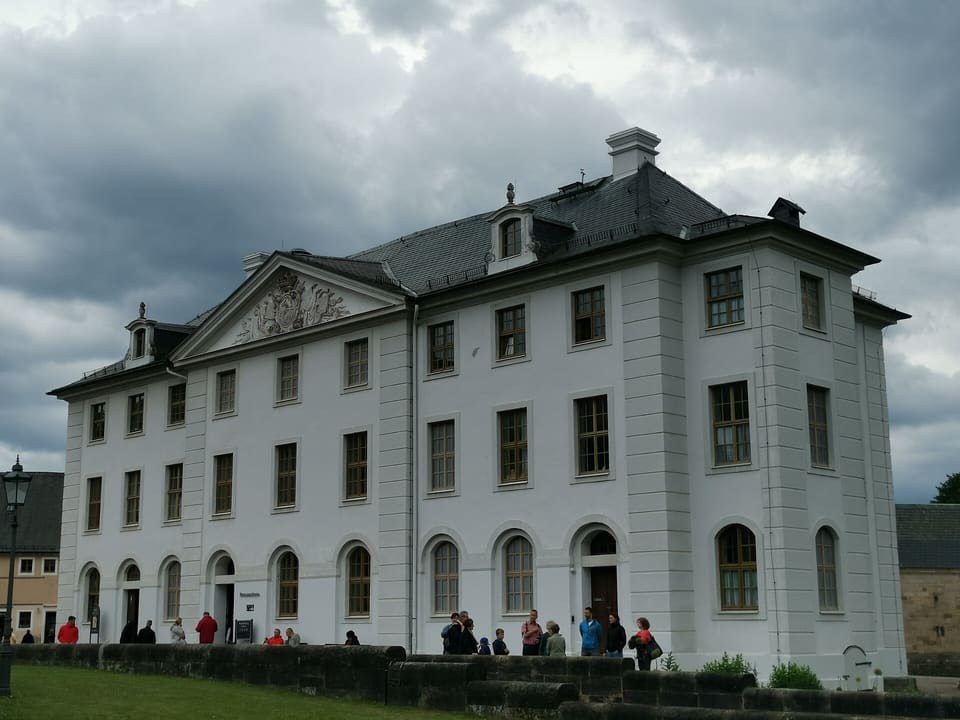
The Brunnenhaus on the fortress. Photographed on 20 June 2020.
Z thomas Wikimedia Commons CC BY-SA 4.0
Johann Friedrich Böttger, co-inventor of European porcelain, and the Social Democrat August Bebel were among the prisoners of the fortress's state prison. A Königstein wine barrel holding 238,600 litres stood in the cellar of the Magdalenenburg until 1819. In 2005 a second lift, the Panoramalift, was built on the spot where the fortress's last outside lift had stood. The chimney-sweep journeyman Sebastian Abratzky climbed the Königstein barefoot through a rock cleft.
Bad Schandau
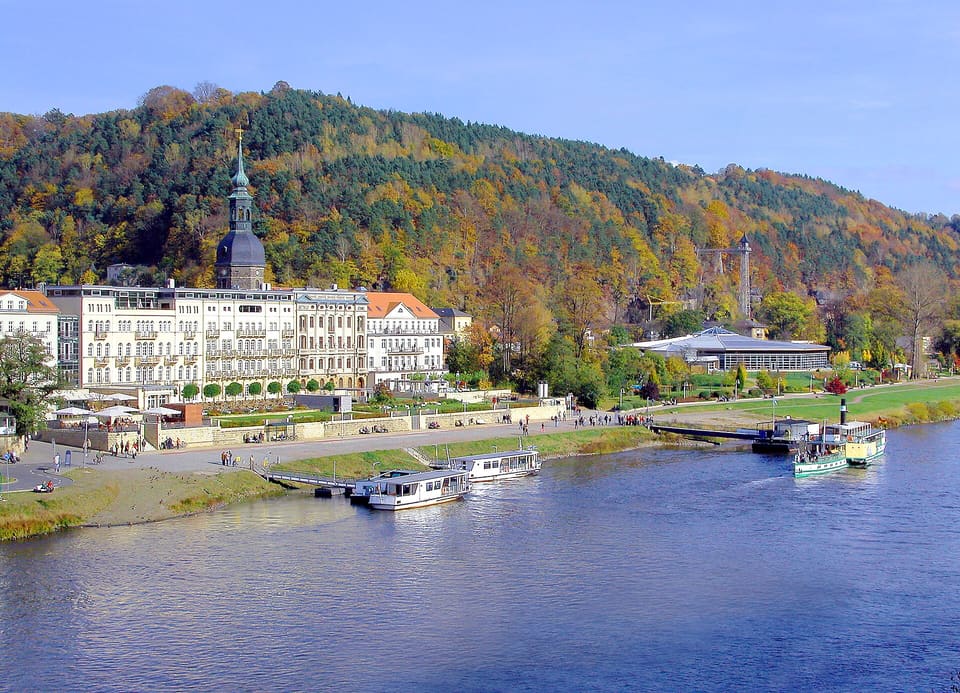
Bad Schandau and the Elbe, with paddle steamers at the landing stage. Photographed on 18 October 2008.
Jörg Blobelt Wikimedia Commons CC BY-SA 4.0
Schandau was first mentioned in a document in 1430 and was called a small town (Städtchen) in 1445. German settlers founded a trading post at the start of the 14th century on an alluvial cone where the Kirnitzsch flows into the Elbe. The Historischer Personenaufzug (historic passenger lift) is a 50-metre-high steel-frame tower built in 1904 in Art Nouveau (Jugendstil) style, with a viewing platform.
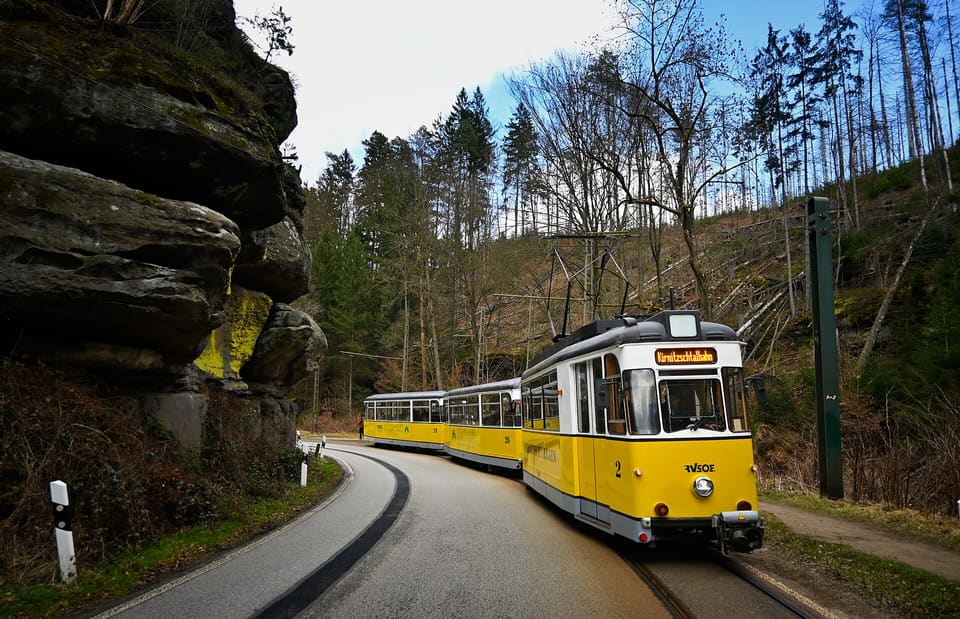
A Kirnitzschtalbahn tram. Photographed on 29 March 2026.
Oleksandr Dede Wikimedia Commons CC BY-SA 4.0
The Kirnitzschtalbahn, a tram line, has carried hikers, tourists and spa guests since 1898. The NationalparkZentrum Sächsische Schweiz, the national park's visitor centre in Bad Schandau, was opened to the public on 24 October 2001 after four years of planning and building. Since 1902 the botanical garden of Bad Schandau has grown plants of the Elbe Sandstone Mountains and the Alps and of similar climates in Asia and North America. The rock of the Elbe Sandstone Mountains was laid down as thick sediment layers on the floor of a Cretaceous inland sea over a period of 7 million years.
Bautzen
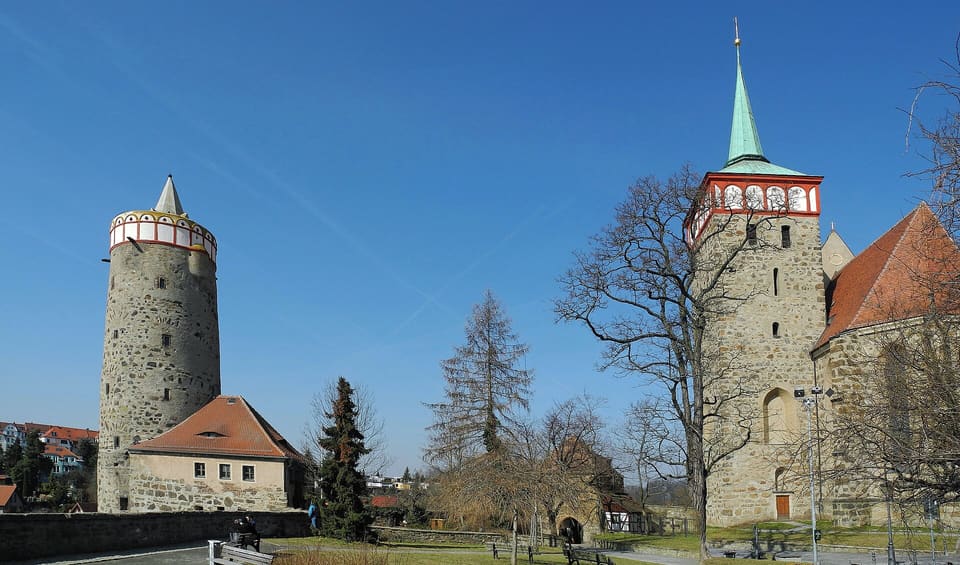
The Alte Wasserkunst and the tower of the Michaeliskirche. Photographed on 25 March 2018.
SchiDD Wikimedia Commons CC BY-SA 4.0
Bautzen was first mentioned in writing in 1002, as Budissin, by the chronicler Thietmar of Merseburg. The city says its Reichenturm, 56 m high, leans 1.41 m to the north-west. Since 1524 the Dom St. Petri (St. Peter's Cathedral) has been used jointly by the Roman Catholic and the Evangelical Lutheran church; the German heritage foundation lists it as a Simultankirche, a church shared by two confessions. The Alte Wasserkunst was built in its present form in 1558 by Wenzel Röhrscheidt the Elder.
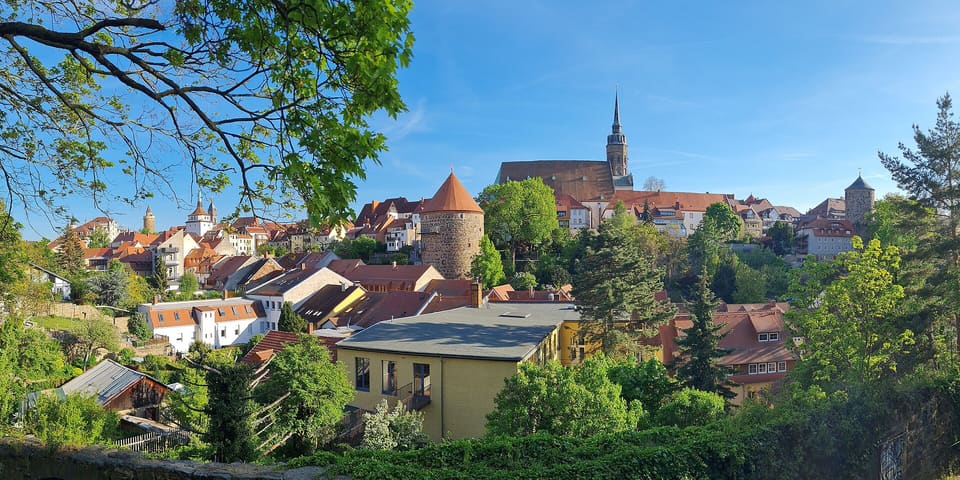
The old town of Bautzen. Photographed on 1 May 2025.
Derbrauni Wikimedia Commons CC BY 4.0
The permanent exhibition of the Sorbian Museum (Serbski muzej) is devoted to the cultural history of the Sorbs from the Middle Ages to the present. The Sorbian National Ensemble was founded in 1952 at the initiative of the Domowina, the national umbrella organisation of the Lusatian Sorbs. According to the city, the signs on all streets and squares and at public institutions are bilingual, German and Sorbian. Today the former Bautzen II prison serves as the Gedenkstätte Bautzen (Bautzen Memorial).
Görlitz
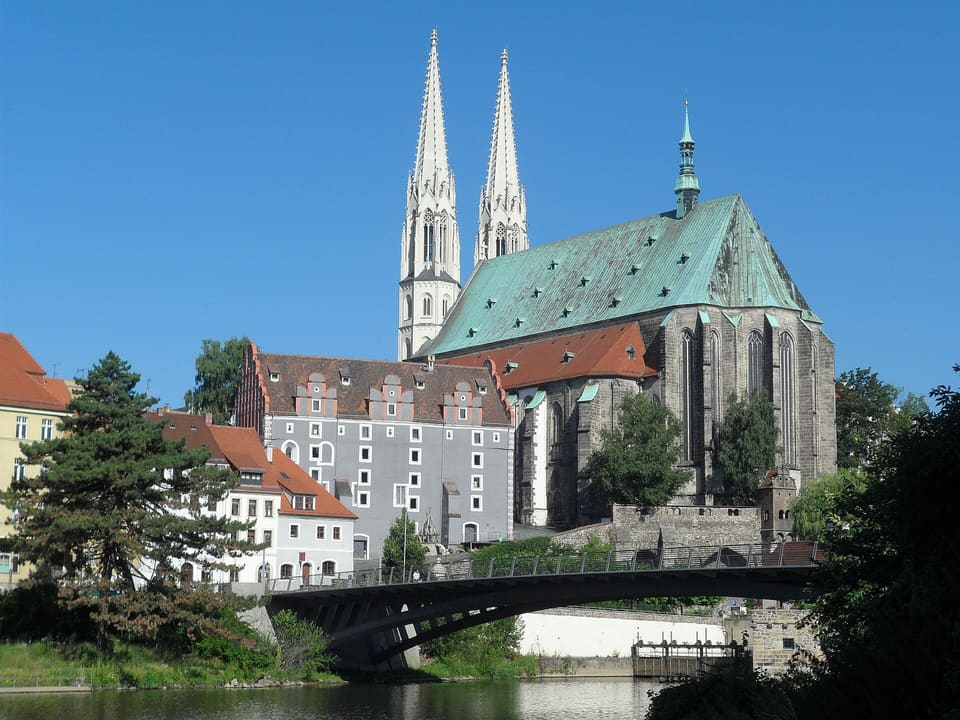
The Peterskirche and the bridge over the Neisse. Photographed on 16 July 2011.
Schläsinger Wikimedia Commons CC BY-SA 3.0
Together with Zgorzelec, on the eastern side of the Neisse in Poland, Görlitz declared itself the Europastadt (European city) Görlitz/Zgorzelec in 1998. According to the city, Görlitz developed around 1220 in the area of today's Untermarkt, as a trading place for long-distance merchants. The city has about 4,000 individual monuments, largely restored, from Gothic, Renaissance, Baroque, Jugendstil and Gründerzeit.
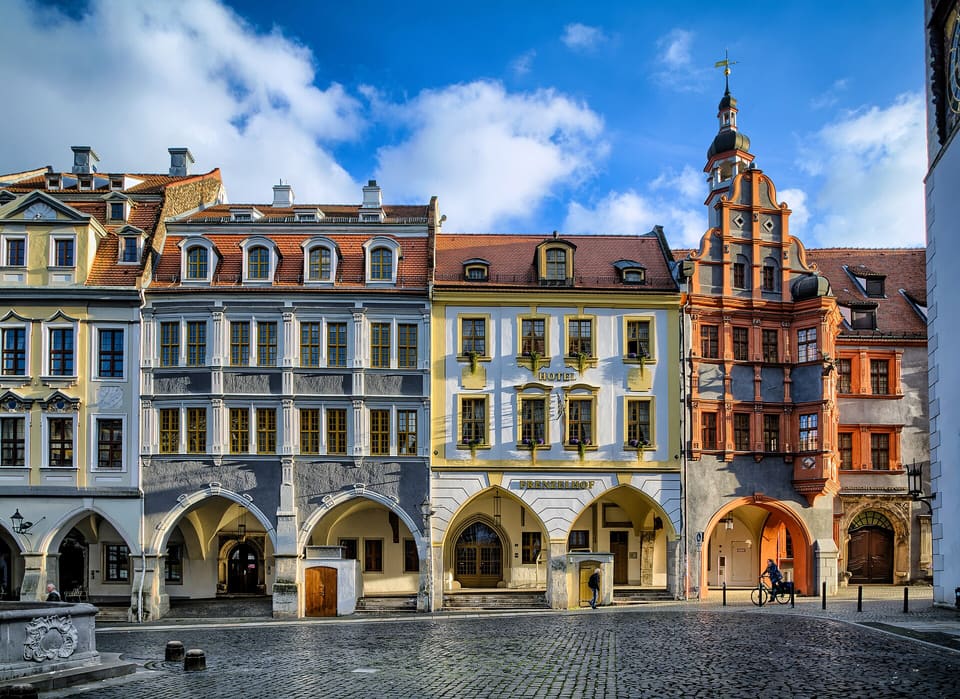
The west side of the Untermarkt. Photographed on 4 October 2022.
Rolf Kranz Wikimedia Commons CC BY-SA 4.0
The Sonnenorgel (Sun Organ) of the Peterskirche dates from 1703, when the Evangelical town church of St. Peter and Paul received a new organ. The Heilig-Grab-Anlage (Holy Sepulchre complex) is a replica of the principal parts of the Church of the Holy Sepulchre in Jerusalem. The Barockhaus was built in 1726–1729 as a residence and business house for the textile merchant Johann Christian Ameiß.