History
Dresden is first mentioned in a document of 1206, and Duke Albrecht chose it as his residence in 1485. The entries below are in date order, newest last, and each date is one its sources give.
Fred Romero from Paris, France Wikimedia Commons CC BY 2.0
Timeline
-
Dresden is first mentioned in a document issued there, in which the Margrave of Meissen settled a dispute between the Bishop of Meissen and the Burgrave of Dohna.
-
After the Wettin lands were divided, Duke Albrecht chose Dresden as his residence. From this year the Residenzschloss was the permanent seat of Saxony’s rulers.
-
Moritz became Elector, and Dresden became the capital and residence city of the Protestant Electorate of Saxony.
-
18th century
Augustus the Strong, as King of Poland, and after him his son Augustus III had Dresden extended as a royal residence. The Zwinger was built for Augustus the Strong in the early 18th century.
-
–
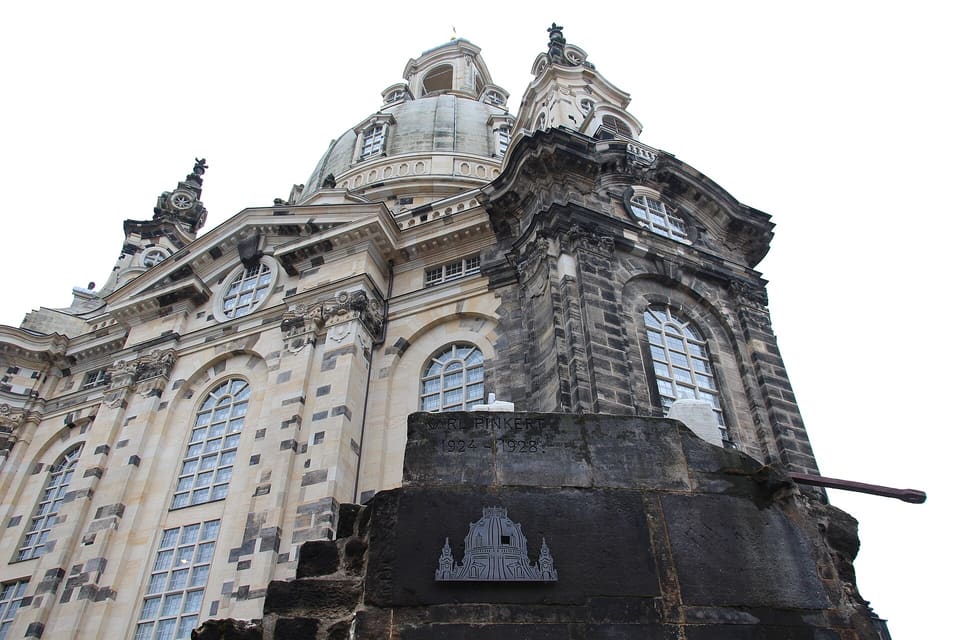
The Frauenkirche was built to designs by George Bähr.
-
Bernardo Bellotto came to Dresden from Venice. The Gemäldegalerie Alte Meister holds two of his views of the city from the right bank of the Elbe, dated 1747 and 1748.
-
Gottfried Semper’s first opera house in Dresden opened.
-
During the May Uprising a fire damaged the Zwinger; it was rebuilt.
-
Semper’s first opera house burned down.
-
A second opera house, again designed by Gottfried Semper, was completed. It opened on 2 February.
-
The Loschwitzer Brücke, known as the Blaues Wunder, opened between Loschwitz and Blasewitz.
-
–
Air raids hit Dresden between 13 and 15 February 1945. In that month the Zwinger was heavily damaged, the Residenzschloss burned out almost completely, the Semperoper was almost completely destroyed, and the Frauenkirche burned out and collapsed.
-
1960s
The rebuilding of the Zwinger, begun in 1945, was finished.
-
The rebuilt Semperoper reopened, forty years after its destruction, with Weber’s Der Freischütz. The rebuilding of the Residenzschloss also began in the 1980s.
-
Demonstrators on Prager Straße chose 23 representatives to talk to Mayor Wolfgang Berghofer; the group became known as the “Gruppe der 20”.
-
Chancellor Helmut Kohl spoke in front of the ruin of the Frauenkirche and said he wanted to hold to the goal of the unity of the nation.
-
The ruins of the Frauenkirche had stood in the city centre for almost fifty years when the first stone of the rebuilding was set.
-
The Elbe flooded in Dresden.
-
The World Heritage Committee inscribed the Dresden Elbe Valley on the World Heritage List as a cultural landscape.
-
The rebuilt Frauenkirche was consecrated.
-
The World Heritage Committee decided to delete the Dresden Elbe Valley from the World Heritage List. UNESCO’s decision names the construction of the Waldschlösschen Bridge as the reason.
-
A flood on the Elbe peaked at the Dresden gauge.