Residenzschloss
The Residenzschloss (English: Royal Palace) was the residence of the Saxon electors and kings and is now a museum complex of the Staatliche Kunstsammlungen Dresden.
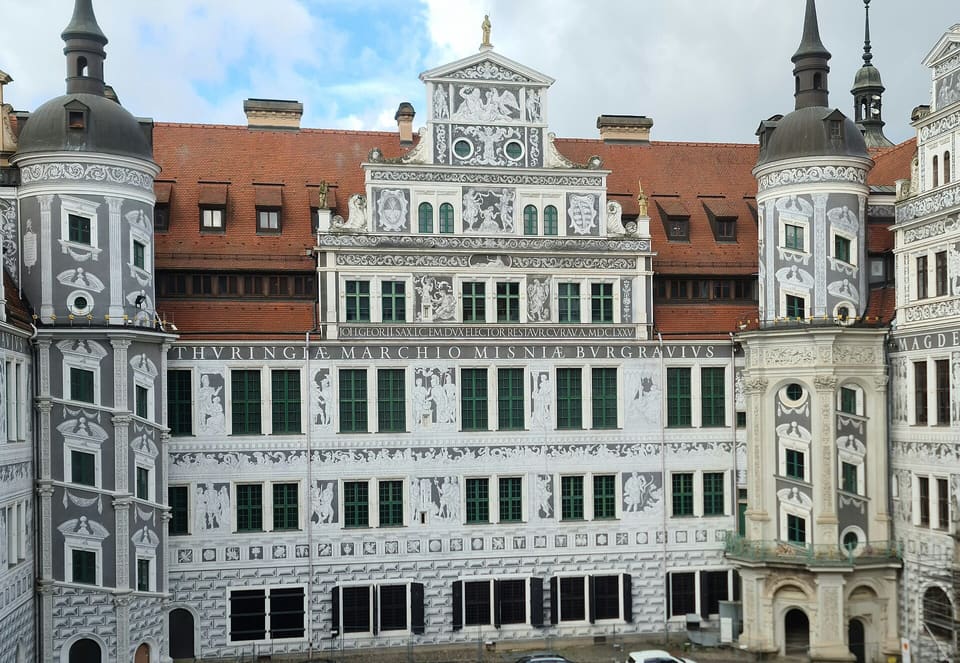
Ricardalovesmonuments Wikimedia Commons CC BY-SA 4.0
What it is
The palace holds the Historic and the New Green Vault, the Kupferstich-Kabinett, the Rüstkammer (Armoury) and the Münzkabinett, plus the Royal State Apartments, the Türckische Cammer and the Riesensaal.
The Green Vault is the treasury of Augustus the Strong, set up in the palace in the 1720s. The Historic Green Vault is in the original ground-floor rooms and the New Green Vault one floor above.
The Saxon electors' Kunstkammer was in the palace, and much of what the museums hold today goes back to it.
History
The palace has been a seat of the Saxon rulers since the 15th century. Under Elector Moritz (1548 to 1556) it was given Renaissance façades with sgraffito decoration. Sgraffito is again visible in the Great Courtyard (Großer Schlosshof).
A fire in 1701 destroyed parts of the palace. Large parts were rebuilt in Baroque style around the wedding of Augustus the Strong's son in 1719. From 1889 the outer façades were redesigned in Neo-Renaissance style, which the palace shows from the outside today.
In the air raids of February 1945 the palace burned out almost completely. The ruins were not rebuilt for decades. Rebuilding as a museum complex began in the 1980s and continued after 1990.
The Hausmannsturm
The core of the Hausmannsturm dates from around 1400. It was raised to its height of 100 metres between 1674 and 1676, to a design by Wolf Caspar Klengel.
The Kleiner Schlosshof
The Kleiner Schlosshof (small courtyard) was built in the late 16th century and has been reconstructed. A transparent roof covers it. The architect Peter Kulka (1937 to 2024) designed the roof.