Zwinger
The Zwinger (German: Dresdner Zwinger) is a Baroque ensemble of pavilions and galleries around a courtyard, now home to museums of the Staatliche Kunstsammlungen Dresden.
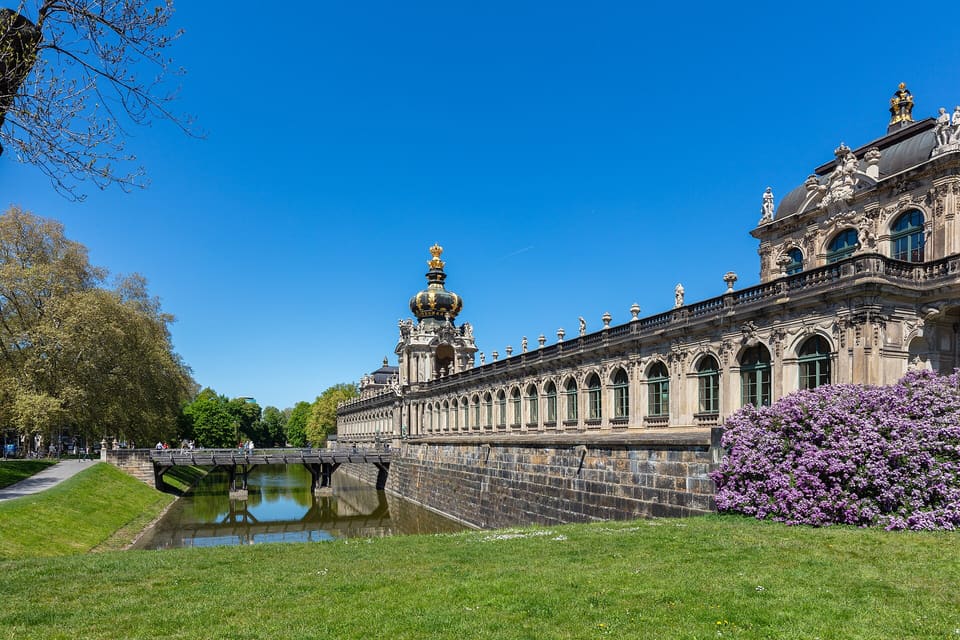
Diego Delso Wikimedia Commons CC BY-SA 4.0
What it is
The name Zwinger refers to the site between the inner and the outer fortification wall of the city. The courtyard has lawns and fountain basins.
The Zwinger houses the Gemäldegalerie Alte Meister with the Skulpturensammlung bis 1800, the Porzellansammlung and the Mathematisch-Physikalischer Salon.
History
Augustus the Strong commissioned the Zwinger in 1709. It was built as an orangery and a festival ground for the court. In 1719 the wedding celebrations of Crown Prince Friedrich August were held there. Matthäus Daniel Pöppelmann was the architect and Balthasar Permoser the sculptor. The buildings were completed in 1728.
From 1728 the pavilions and galleries housed the court's collections: a library, natural science collections and prints. Gottfried Semper's building was built from 1847 to 1855. It closes the courtyard on the Elbe side and houses the Gemäldegalerie Alte Meister. A fire during the May Uprising of 1849 damaged the Zwinger, and it was rebuilt.
The air raids on Dresden in February 1945 heavily damaged the Zwinger. Rebuilding began that year and was finished in the 1960s.
Crown Gate and carillon
The Crown Gate (Kronentor) dates from 1714. It stands in the middle of the long gallery and is topped by a crown. The city-side pavilion has a carillon of Meissen porcelain bells, installed in the 1930s.